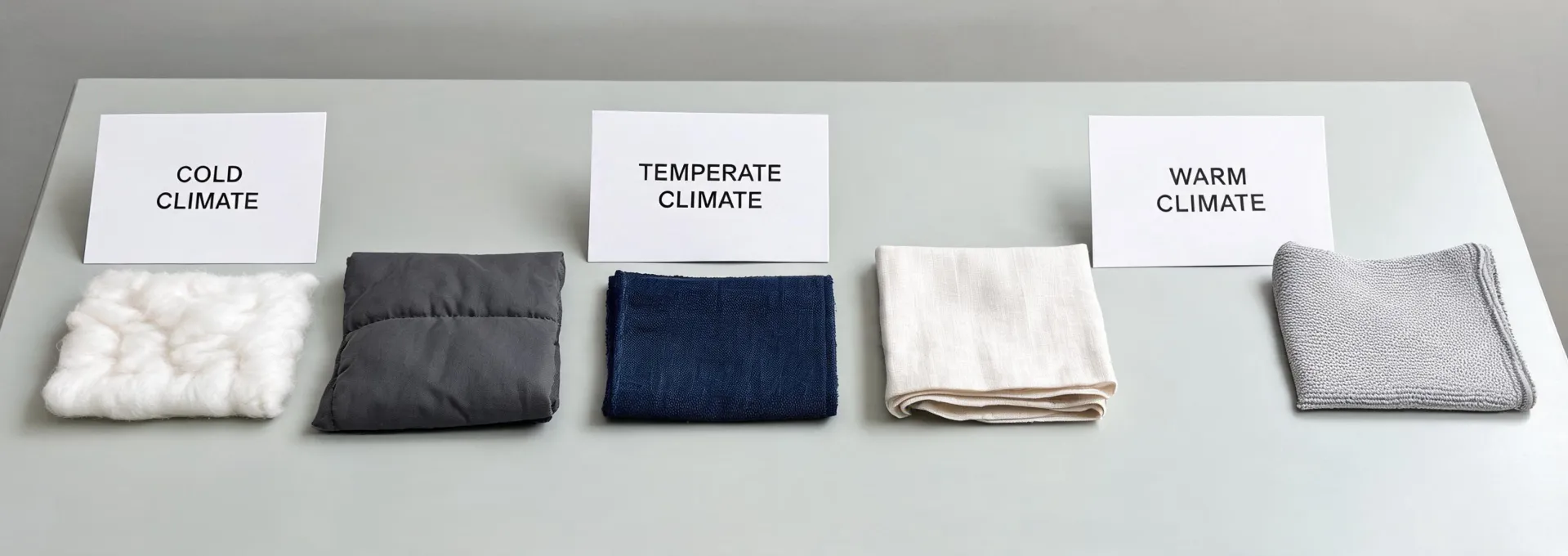
IND-F · use-environment map
THERMOLITE Application Questions by Use Environment
Applications help define a test brief; they do not turn partner garments, socks, bedding, or sleeping bags into THERMOLITE® catalog products.
Four environment clusters
Translate intended use into construction questions.
Fiber route in a fabric
For activewear, intimate apparel, denim, socks, underwear, and ready-to-wear applications, the first question is usually how an ingredient fiber enters the yarn and fabric construction. Record blend, linear density, knit gauge or weave, GSM, finishing, air permeability, moisture management method, and care exposure.
Insulation inside an assembly
Outerwear and accessories may use batting or blown insulation between shell and lining. Basis weight, loft, fill distribution, quilting, compression, moisture exposure, coverage, and seam design affect the assembled system. No weight-to-temperature chart is inferred.
Warmth must coexist with job requirements
Workwear evaluation may also consider abrasion, air permeability, drying, repeated care, visibility components, and task mobility. An ingredient warming technology does not establish flame resistance, chemical protection, electrical protection, or PPE compliance.
System geometry matters
Bedding and sleeping-bag applications depend on fill distribution, shell and liner permeability, quilting, compression, humidity, occupant conditions, and the complete test arrangement. A brand ingredient name alone cannot predict comfort or a universal operating temperature.
Describe the environment
Build a review brief from the use conditions inward.
State the application, body or equipment zone, expected climate, activity, layer position, fiber or insulation form, construction, care route, and evidence required. Do not submit a retail SKU as though it were an ingredient technology.